Anime Girl Text to Speech

Quick answer
To get natural anime girl text to speech, describe the voice by pitch, breathiness, pace, ending inflection, and emotion instead of naming a character. Pick one archetype, such as soft-spoken or energetic heroine, write lines with expressive punctuation, and keep sentences short so the delivery stays lively.
Key takeaways
- Anime girl voices are built from five traits: pitch, breathiness, pace, line endings, and emotional range.
- Five original archetypes cover most needs: soft-spoken, energetic heroine, cute / chibi, cool / aloof, and big-sister type.
- A strong Voice Design prompt fits in one or two sentences and names age, pitch, texture, pace, accent, and use case.
- Punctuation and interjections ("Eh?", "Mm!", "Hey—") do more for expressiveness than any single setting.
- Create original voices only. Prompting for a specific character or voice actor is not allowed and usually sounds worse anyway.
Why most anime girl TTS sounds flat
Generic text to speech sounds flat in anime-style content because anime delivery is built on contrast. Lines jump from a whisper to a shout, end with a lifted tone, and lean heavily on short reactions. A standard voice reads all of that at one even level, so the personality disappears.
There are three usual culprits:
- The voice is too "neutral adult." Anime girl voices typically sit higher and lighter, with a younger feel.
- The script reads like an essay. Long sentences with no interjections give the voice nothing to react to.
- Every line has the same energy. Without calm lines, the excited ones do not stand out.
Fixing these is mostly about how you describe the voice and how you write the lines, which the rest of this guide walks through.
How to describe an anime girl voice
The most useful way to describe an anime girl voice is by sound, not by reference. Instead of "like the girl from that show," list what you would hear: how high, how airy, how fast, how lines end, and what emotions she shows.
| Trait | What to specify | Example wording |
|---|---|---|
| Pitch | How high the voice sits | "high-pitched," "light mid-high," "slightly low for a girl" |
| Texture | Clear, airy, or bright | "clear and sweet," "soft and breathy," "bright and crisp" |
| Pace | Overall speed and rhythm | "quick and bouncy," "slow and gentle," "measured, a bit clipped" |
| Line endings | What happens at the end of a phrase | "rising, playful endings," "soft trailing endings," "flat, cool endings" |
| Emotional range | The moods she moves between | "cheerful to determined," "shy to flustered," "calm with dry humor" |
| Age feel | Apparent age | "teen, around 16–18," "young adult, early 20s" |
| Accent | Pronunciation of the target language | "neutral American English," "standard Japanese," "standard Mandarin" |
You can write the prompt in English or Chinese. What matters is that each trait is concrete.
Five original anime girl voice types
These archetypes are generic voice types used across animation and games. Each one below comes with a copy-ready Voice Design prompt you can paste and adjust.
| Archetype | Pitch & texture | Pace | Line endings | Best for |
|---|---|---|---|---|
| Soft-spoken | Mid-high, breathy, gentle | Slow | Soft, trailing | Quiet scenes, ASMR-style intros, slice-of-life narration |
| Energetic heroine | Mid-high, clear, strong | Medium-fast | Firm, rising on resolve | Action scenes, game dialogue, motivational lines |
| Cute / chibi | High, sweet, bouncy | Fast | Playful, lifted | Mascots, short-form clips, comedic reactions |
| Cool / aloof | Mid, clean, slightly dry | Measured | Flat, clipped | Rival characters, calm narration, deadpan humor |
| Big-sister type | Mid, warm, smooth | Relaxed | Gentle, teasing | Guides, tutorials, warm companion characters |
1. Soft-spoken anime girl
Female, about 17. Soft, airy, gentle voice with a light breathiness and mid-high pitch. Slow, careful pace with soft trailing endings and small pauses, as if slightly shy. Neutral American English accent. Calm and tender, able to sound flustered when surprised. Anime-style soft-spoken character.
Sample 1 (original script):
"Um… thank you for waiting. I wasn't sure you'd come. I made tea — it's still warm, I think."
2. Energetic heroine
Female, about 18. Clear, bright, confident voice with mid-high pitch and strong projection. Medium-fast pace, firm delivery that rises with determination. Neutral American English accent. Brave and passionate, switching between resolve and excitement. Anime heroine and game protagonist style.
Sample 2 (original script):
"We've come too far to turn back now. Stay behind me — I'll handle this. Ready? Let's go!"
3. Cute / chibi girl
Female, about 15. High-pitched, sweet, bouncy voice with a playful, slightly sing-song quality. Fast, lively pace with lifted, cheerful endings. Neutral American English accent. Happy and mischievous, quick to sound pouty or excited. Cute mascot and chibi character style.
Sample 3 (original script):
"Hey! You found my secret snack stash! Hmph… okay, okay — you can have ONE. Just one!"
4. Cool / aloof girl
Female, about 19. Clean, mid-pitched voice with a slightly dry, composed tone. Measured pace, clipped phrasing, and flat endings with little emotional color. Neutral American English accent. Calm and detached, with a hint of dry humor. Cool rival or quiet strategist character style.
5. Big-sister type
Female, early 20s. Warm, smooth, mid-pitched voice with a relaxed, confident delivery. Unhurried pace with gentle, slightly teasing endings. Neutral American English accent. Caring and playful, reassuring but a little mischievous. Kind older-sister character style.
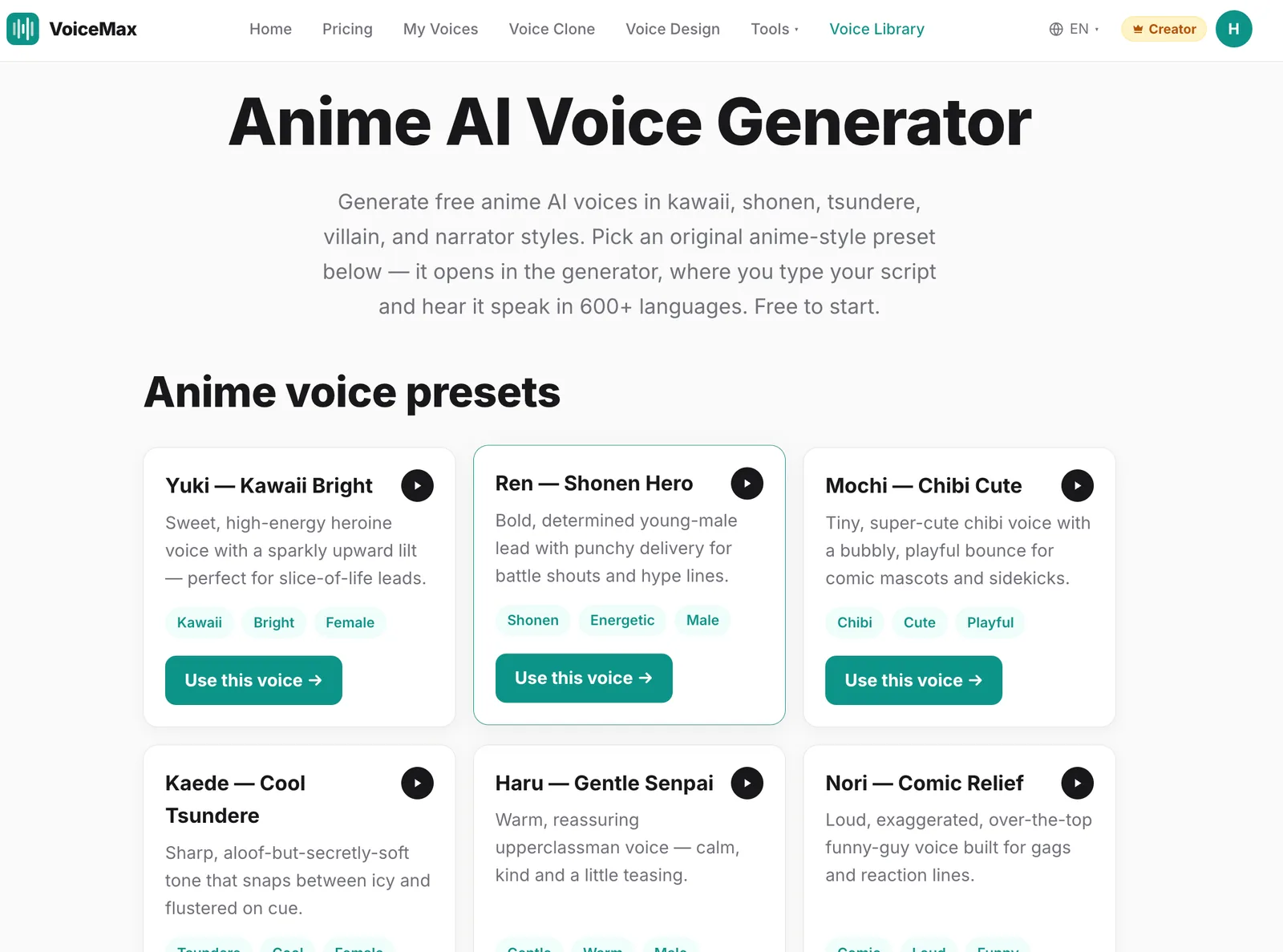
If you would rather start from a ready-made voice than design one, the anime AI voices in the voice library include an anime heroine, a shonen-style hero, a villain, and more.
Writing lines that sound expressive
The script decides most of the expressiveness, because the voice reacts to what is on the page. These techniques work across all five archetypes:
- Use interjections. "Eh?", "Hmm…", "Ah—!", and "Hmph" give natural reaction beats. Keep them short and spelled the way you want them pronounced.
- Control pauses with punctuation. An ellipsis (…) creates hesitation; a dash (—) creates an interruption; a comma gives a quick breath.
- Keep sentences short. Lines of 4–10 words keep delivery bouncy. Long sentences flatten out.
- Mark emphasis with capitals sparingly. One capitalized word ("just ONE") can add stress; whole capitalized sentences tend to sound shouted.
- Alternate energy. Put a calm line before an excited one so the contrast is audible.
- Read it aloud first. If you stumble, the voice probably will too.
| Want | Write it like this | Avoid |
|---|---|---|
| Shy hesitation | "I… I didn't mean to." | "I did not mean to do that, sorry." |
| Surprise | "Eh? Wait — you're here?" | "I am surprised that you are here." |
| Determination | "I won't lose. Not this time." | "I am determined not to lose this time." |
| Playful teasing | "Mm? You're blushing~" | "You appear to be blushing." |
| Excited burst | "We did it! We actually did it!" | "We have succeeded at our goal!!!!" |
Note on the tilde (~): some voices read it as a lilt, others ignore it. Test it on a short line before relying on it.
How to create anime girl TTS with VoiceMax
The quickest workflow is to design the voice once, save it, and then generate every line from the saved voice.
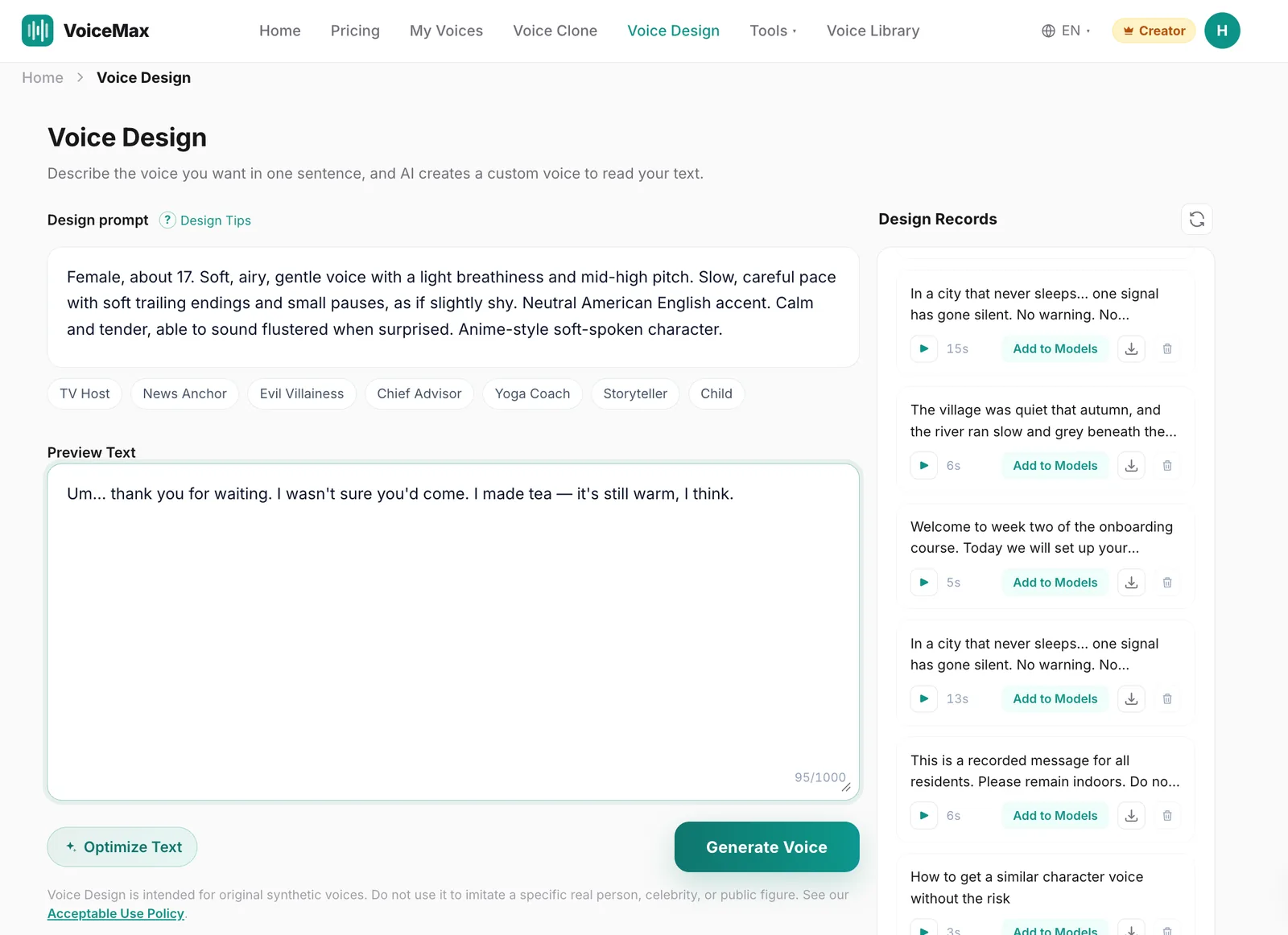
- Open Voice Design and paste one of the five prompts above. Change the age or accent if your project needs it.
- Preview with a real line from your script, ideally one with an interjection and a pause, since that is where personality shows.
- Adjust one trait at a time. If she sounds too old, lower the age; too flat, add "rising, playful endings"; too breathy, change "airy" to "clear."
- Save the voice with "Add to Models" on a 5–30 second design result.
- Generate your lines from the saved voice. For long scenes, generate in short sections so each line keeps its energy.
- Download MP3 or WAV and drop the files into your editor or game engine.
Fixing common problems
| Problem | Likely cause | Fix |
|---|---|---|
| Sounds like an adult narrator | Age or pitch too vague | Add a specific age and "high-pitched" or "mid-high pitch" |
| Sounds robotic | Long, formal sentences | Split lines, add interjections and pauses |
| Sounds over-excited everywhere | Every line has "!" | Keep exclamation marks for peaks; add calm lines |
| Breathiness hides the words | Prompt says "very breathy" | Use "light breathiness" plus "clear articulation" |
| Inconsistent voice across lines | Generating long scenes from the design preview | Save the voice and generate from the saved model |
| Wrong accent in another language | Prompt accent doesn't match script | Write the accent for the target language, e.g. "standard Japanese" |
Creator-plan emotion control can push a line toward happy, sad, surprised, or angry without changing the voice's timbre, which is useful for reaction-heavy scenes.
Beyond anime: other female voices
Anime styles are only one corner of female voice work. If you need a natural narrator, a YouTube explainer, or a warm brand voice instead, the female voice generator page has ready-made girl and female AI voices you can use right away.
Keep it original
Anime fans often want a voice that sounds like a favorite character. That is exactly what you should not prompt for. Character voices belong to their creators and performers, and imitating a specific voice actor is not allowed in VoiceMax. Describing the traits you like — pitch, energy, endings, emotion — gives you a voice that fits the same role while being entirely your own.
Frequently asked questions
What is anime girl text to speech?
Anime girl text to speech converts written lines into a voice with anime-style delivery: usually higher pitch, expressive line endings, quick reactions, and a wide emotional range. With VoiceMax you design the voice from a short description, save it, and then generate as many lines as you need from that saved voice.
How do I describe an anime girl voice for AI?
Describe what you would hear rather than who it sounds like. Include pitch, texture such as clear or breathy, pace, how lines end, emotional range, apparent age, and accent. For example: "Female, about 17, soft and airy, mid-high pitch, slow pace, soft trailing endings, calm but easily flustered, neutral American English."
Can I make a voice that sounds like a specific anime character?
No. Voice Design is for original synthetic voices, and imitating a specific character, voice actor, or real person is not allowed under the VoiceMax Acceptable Use Policy. Character voices are tied to their creators and performers. Instead, describe the traits you like so you get an original voice that fits the same role.
Why does my anime voice sound robotic?
Usually the script, not the voice, is the problem. Long, formal sentences and identical energy on every line flatten the delivery. Split lines into 4–10 words, add interjections like "Eh?" or "Hmm…", use ellipses and dashes for pauses, and keep exclamation marks for real peaks.
Can anime girl voices speak Japanese or other languages?
Yes. VoiceMax supports 600+ languages, so you can generate anime-style lines in Japanese, English, Chinese, Spanish, and more. Put the target accent in your prompt, such as "standard Japanese," and preview the voice with a line written in that language before generating a full scene.
Can I use anime girl voices commercially?
Yes, on a paid plan. Commercial rights start on the Starter plan and cover monetized videos, games, apps, and client work. The Free plan is for personal use only. Because the voices you design are original synthetic voices, you avoid the rights problems that come with copying an existing character.